What Is a JWT Secret Key?
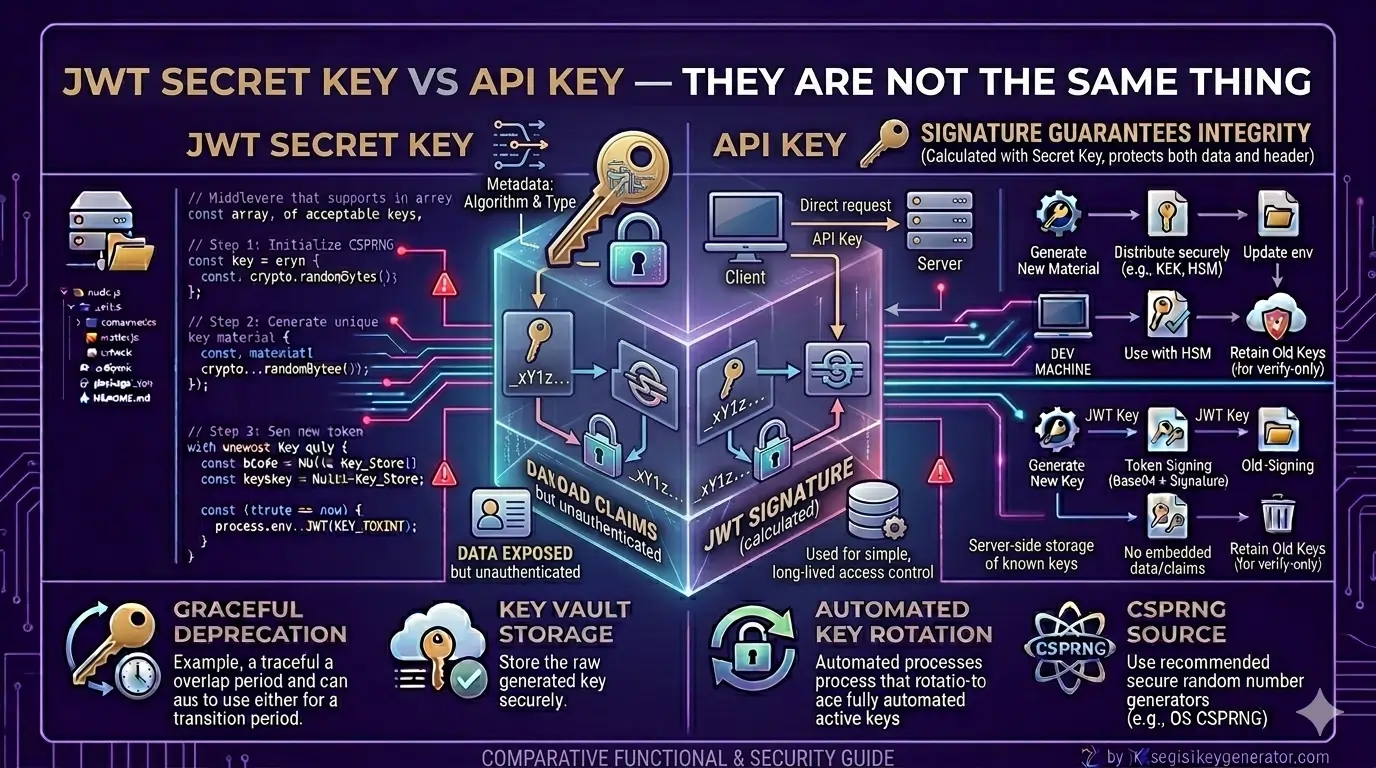
The JWT Secret Key is a private key used by the server to sign the JWT token. When the server creates a JWT, it combines the header and payload to create a signature. The secret key is used to create this signature.
This key is very secret and is never made public. To understand more about how it works inside the token, see our guide on what actually happens inside a JWT.
What Is an API Key?
An API Key is a simple key used to identify a client. When an app or user accesses an API, they send their API Key. This lets the server know who sent the request.
A private server-side key that signs and verifies tokens. It provides cryptographic proof that a token is authentic and untampered.
A simple identifier sent by a client with each request to tell the server who is calling. It provides identification, not cryptographic security.
Main Difference Between JWT Secret Key and API Key
| Feature | JWT Secret Key | API Key |
|---|---|---|
| Function | Sign and verify the token | Identify the client |
| Who Uses It? | The server (creates & verifies) | The client (sends), server (checks) |
| Is It Secret? | Yes — always | Mostly, but sometimes semi-public |
| Security Level | High | Medium |
| Where Stored? | Server only (env variable) | Client or server |
| Can It Change? | Rarely (invalidates all tokens) | Yes — easily rotated |
Let's Understand With a Simple Example
Let's say there's a website. Here's how both keys work together in a real request flow:
- When a user logs in, the server creates a JWT
- A secret key is used to sign this JWT
- The user then makes an API call — sending the API key or JWT with the request
- The server checks whether the request is valid
Where Are JWT Secret Keys and API Keys Used?
- Authentication system
- Login / Signup flow
- Secure token generation
- Public APIs
- Third-party services
- Rate limiting (controlling how many times an API can be called)
Things to Keep in Mind
- The JWT secret key should never be sent to the client side — store it in environment variables on the server only. Learn more about JWT secret key best practices
- Never make the API key public without need — treat it as a credential
- JWT is more secure because it contains a cryptographic signature
- The API key is only for identification — it does not provide complete security on its own
For a deeper understanding of how API authentication works, the OWASP API Security Project is an authoritative resource covering best practices for securing APIs in production environments.
Another Small Difference
| Attribute | JWT Secret Key | API Key |
|---|---|---|
| Where Is It Stored? | Server only (env variable) | Client or server |
| Can It Change? | Rarely (invalidates existing tokens) | Yes — easily rotated anytime |
The Bottom Line
So now it's clear that the JWT Secret Key and the API Key are two different things. The JWT Secret Key's function is to provide security. The API Key's function is to provide identity. If you use the right thing in the right place, your system will be more secure and efficient.
- JWT Secret Key → signs and verifies tokens → provides security
- API Key → identifies the client → provides identity
- Never send the JWT secret key to the client side
- Never expose an API key publicly without a specific need
- Use JWT for authentication flows; use API keys for service-to-service identification
🔐 Need a secure JWT secret key for your project? Use jwtsecretkeygenerator.com to generate a production-ready key instantly — free, browser-based, and never stored on any server.
Frequently Asked Questions
What is the difference between a JWT secret key and an API key?
A JWT secret key is a private server-side key used to sign and verify JWT tokens for authentication. An API key is a simple identifier sent by a client to tell the server who is making the request. JWT secret keys provide cryptographic security; API keys provide identification only.
Is a JWT secret key the same as an API key?
No. A JWT secret key and an API key are not the same. A JWT secret key is kept only on the server and is used to create and verify cryptographic signatures. An API key is shared with clients and is used to identify who is calling an API.
Which is more secure — a JWT or an API key?
JWT is more secure because it contains a cryptographic signature that proves the token has not been tampered with. An API key is only for identification purposes — it does not provide the same level of security because anyone who has the API key can use it.
Where should a JWT secret key be stored?
A JWT secret key should be stored only on the server — typically in an environment variable (.env file). It should never be exposed to the client side, committed to a public repository, or hardcoded in your source code.